How to Track DeFi and NFTs: Every Position Type, Explained
To track DeFi positions and NFTs, add your wallet's public address to a tracker that decodes on-chain positions, such as Zerion's free watch-only tracker or MetaMask Portfolio's DeFi dashboard, and keep a tax-capable tracker such as Koinly for the transaction history. No API key or signature is needed, because everything a DeFi position consists of is already public on the blockchain. The hard part is not access but interpretation: liquidity-pool shares, staked receipt tokens, loans and NFTs each need decoding and pricing, and that is where trackers disagree.
This guide goes position type by position type: what each one is, how a tracker values it, which kind of tool sees it, and how to check the number. Tool details were read on the vendors' own pages on 9 and 10 Oct 2026.
Why DeFi positions are hard to track
A plain token balance is one number on one contract. A DeFi position is usually a claim on something else. When you deposit into a liquidity pool you receive an LP token representing a share of the pool; when you stake through many services you receive a receipt token; when you lend you may hold a deposit token and, if you borrow, a debt token that counts against you. Rewards may sit unclaimed inside a contract and never appear as a balance at all.
To show a fair value, a tracker has to find each of these contracts, recognise which protocol issued them, work out what your share is worth right now and net off anything you owe. Every protocol represents positions in its own way, and new ones launch constantly, which is why two trackers pointed at the same wallet can show different totals, and why the honest answer to "which DeFi tracker is accurate" is "check it against the source".
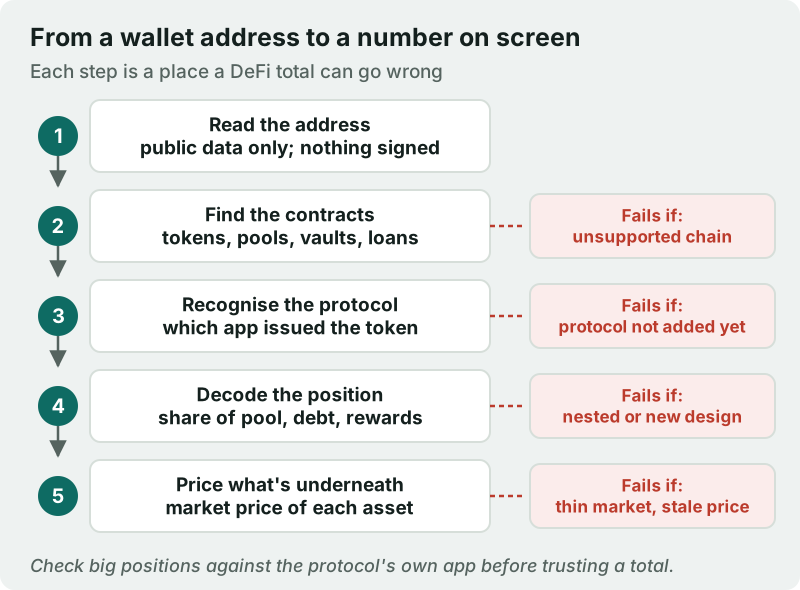
Position types and how each is valued
Liquidity-pool (LP) positions
An LP position is your share of a pool holding two or more assets. Its value is your share of everything in the pool at current prices, plus any fees earned, which means the mix of assets changes as prices move. A good tracker shows the underlying amounts as well as a total. Watch for the difference between what you deposited and what the share is worth now: when prices diverge, the pool rebalances and you can end up with less value than if you had simply held the assets, which a total alone will not explain.
Staked and receipt tokens
Staking through a service often hands you a receipt token for the staked asset. Some receipt tokens grow in number as rewards accrue (rebasing); others stay constant in number while each one becomes redeemable for more of the underlying (value-accruing). A tracker that prices a value-accruing token as if it were the underlying asset will understate it, and one that misses rebases will show a frozen balance. Locked or vesting positions add another wrinkle: they may show a value you cannot actually withdraw yet.
Lending deposits and debts
A lending position has two sides: what you supplied, which earns interest, and what you borrowed, which accrues it. The figure that matters is the net, and next to it how close the loan is to liquidation if collateral prices fall. Some dashboards show only the supplied side, which flatters your net worth. If you borrow, check your position's safety margin in the protocol's own app; a portfolio total is not a risk monitor.
Unclaimed rewards
Rewards that have accrued but not been claimed live inside the protocol's contract, not in your wallet. Zerion says its tracker follows DeFi deposits and rewards; many general trackers ignore unclaimed rewards until they land in your wallet. That is not a loss, just a lag, but it can make a position look smaller than it is.
Which trackers handle DeFi and NFTs best
Trackers fall into four broad designs, and the design predicts what each will see. DeFi dashboards are built to decode live positions; all-in-one apps cover wallets and exchanges and decode some DeFi; tax-ledger trackers reconstruct every transaction so they can compute cost basis, which records DeFi activity faithfully but values positions less directly; and the protocol's own app is the ground truth for its own positions only.
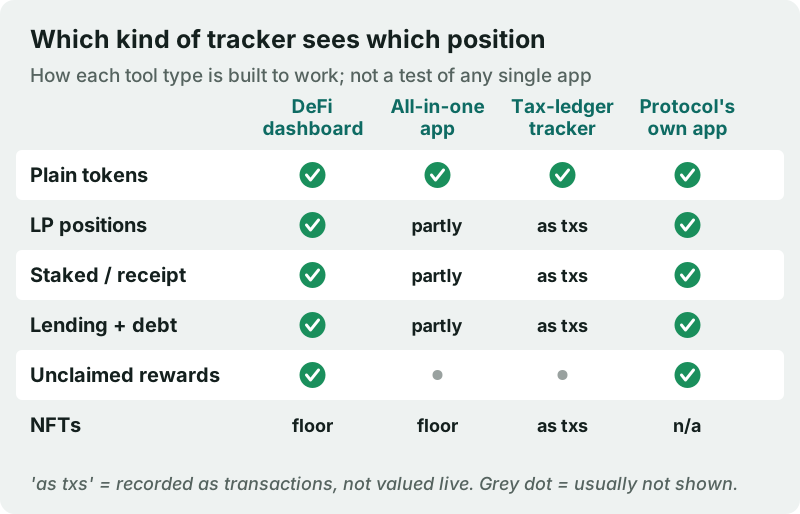
Position dashboards: Zerion, MetaMask Portfolio and DeBank
Zerion's DeFi tracker is free, needs no sign-up and watches any address. It says it discovers tokens, NFTs and DeFi positions, deposits and rewards included, across more than 4,500 protocols and 66 chains, with profit and loss per token available through its Premium pass at $99 a year, paid once with no auto-renewal. MetaMask Portfolio's DeFi dashboard covers nine networks (Ethereum, Optimism, BNB Chain, Polygon, Fantom, Base, Linea, Arbitrum and Sei) and draws its protocol support from an open-source library. DeBank describes itself as a portfolio tracker for Ethereum and EVM chains.
All-in-one apps: CoinStats and rotki
CoinStats combines exchanges and wallets and advertises DeFi and NFT tracking, with profit-and-loss analysis on Premium; its free Basic plan allows 10 portfolios and 20,000 transactions, and Premium is $13.99 a month. rotki is the private option: a local app whose account exists only on your machine, reading EVM chains, Bitcoin, Polkadot, Kusama and Solana, with a free tier limited to the 1,000 most recent events.
Koinly: DeFi as a complete record
Koinly reads wallets by public address and names staking on Solana, lending on Curve and providing liquidity on Uniswap among the activity it handles. Every feature, DeFi included, is free until you buy a tax report or pass 10,000 transactions. Its strength is a full, reconciled history rather than a live position screen, which is what you will want at tax time.
CoinLedger: DeFi and NFT imports
CoinLedger tracks for free with unlimited wallet and exchange syncs, and lists imports from blockchains and DeFi protocols plus support for NFT assets. Like Koinly, it is a record-keeper first; pair it with a dashboard if you want to watch positions move in real time. CoinTracker, by comparison, says DeFi positions need a paid plan.
How to check a DeFi total
Whatever tracker you use, a short audit tells you whether its DeFi figure deserves trust. Do it once when you set the tracker up, and again whenever you open a position in a protocol you have not used before.
- Pick your largest position and open it in the protocol's own app. Compare the amounts of each underlying asset, not just the dollar total.
- If you borrow anywhere, confirm the tracker shows the debt and subtracts it. A total that only counts deposits overstates your net worth.
- For staked or receipt tokens, check that the tracker values them at their redeemable amount rather than one-for-one with the underlying asset.
- Look for rewards waiting to be claimed in each protocol, and note whether the tracker includes them.
- Switch the tracker's chain filter to each network you use, so a position on an unsupported chain cannot hide in the total.
If a tracker fails two of these on your own wallet, treat its DeFi figure as a rough guide and keep the protocol apps as your record of what you actually hold.
NFTs: floor price vs last sale
NFT values in a tracker are estimates, and usually optimistic ones. Most trackers value a collectible at its collection's floor price, the lowest current listing. That is not what your particular item would sell for: rarer items may be worth more, and in a thin market even the floor may not be achievable once you try to sell. Last-sale prices have the opposite problem, since a sale weeks ago says little about today. Treat an NFT figure as a rough indicator, and use a tracker setting that excludes NFTs or lets you value them yourself if you want an honest total.
Spam is the other NFT problem. Wallets receive unsolicited NFTs and tokens, some of them lures to malicious sites. MetaMask's web dashboard launched in 2023 with hidden and suspicious NFTs filtered out of its default view; whatever tracker you use, hide spam rather than interact with it, and never visit a link printed on an NFT you did not buy.
Tax handoff
DeFi activity is taxable in the US even though most DeFi apps send you no forms. The IRS classes digital assets as property, and a 2025 law, Public Law 119-5, nullified the rule that would have required DeFi front-ends to report as brokers. Form 1099-DA reporting therefore comes from custodial brokers, while swaps, LP deposits and claims you make yourself need your own records. A tax-ledger tracker is the practical way to keep them. For NFTs, the IRS lets brokers skip reporting certain NFT sales when a customer's total proceeds are $600 or less for the year, but that is a reporting threshold, not a tax exemption.
This site covers the tracking side in tracking cost basis for taxes. EU and UK users who want local tax output alongside tracking can look at Blockpit, which publishes tax guides for the UK and most EU countries and prices its reports per tax year. For filing itself, use dedicated tax software or a professional; nothing here is tax advice.
Doing it safely
The safety story for on-chain tracking is the simplest in crypto: share a public address, sign nothing, and no tracker can move your funds. What a watch address does expose is privacy. Anyone with the address can see its holdings, and a tracker that links several addresses learns which wallets are yours. If that matters, use a local tool such as rotki or keep separate trackers for separate wallets; our guide to the privacy of portfolio apps covers the trade-off.
If you also add exchange accounts, connect them with read-only keys as described in connecting exchanges safely, and review old token approvals in your wallet from time to time, because an approval you gave a DeFi app months ago is still live until you revoke it. For the full field of trackers, see the best crypto portfolio trackers.
DeFi and NFT tracking: FAQ
What is the best DeFi portfolio tracker?
Is there a good NFT portfolio tracker?
Can a tracker see my DeFi positions without my keys?
Why does my DeFi tracker show the wrong value?
Do I pay tax on DeFi if I get no tax form?
Ready to pick a tracker? See the best crypto portfolio trackers, compared, or read how to track your portfolio safely with read-only keys.